
Implementing AI in Your Company –
With a CTO Who’s Done It
As a CTO, you’re under pressure: the board wants a strategy, your team wants direction, and you’re making AI architecture decisions with no playbook to follow. Implementing AI as a CTO means deciding alone, without a reference point.
I don’t offer a framework or a course. I’ve been a CTO myself – and I’ll guide you through exactly these decisions.



Caught Between Leadership Expectations and Engineering Reality
The pressure comes from above – but the work is waiting below.
Architecture decisions without clear reference points. Tools that change every week. A team that’s either experimenting too much or not at all. AI infrastructure costs that nobody really has a handle on. Not a single leader in your company who’s already been down this road.
You can implement AI in your company. But best not alone – and not without someone who’s already asked the hard questions.
No Guides. No Frameworks. A CTO Who’s Been There.
There’s no shortage of guides, whitepapers, and courses. What’s missing is someone at your level – someone who knows the craft questions: Which architecture actually holds up? Where does build make sense, where does buy? How do you lead your team through AI adoption without it falling apart?
How do you explain AI architecture decisions and costs to the board in language that lands? What is Agentic SDLC – and where does it actually give your engineering real leverage?
What I offer isn’t teacher-to-student. It’s peer-to-peer AI CTO sparring.
What I Keep Seeing in AI Implementations
AI implementations rarely fail because the CTO doesn’t know enough tools. They fail because expectations, accountability, and operational reality don’t line up.
Demos, success stories, LinkedIn posts, and FOMO create a vision nobody has properly validated. Suddenly “Agentic AI” is supposed to solve everything – without being clear about which problem actually needs solving first.
Delivery pressure continues, the board wants speed, the team experiments with tools – and there’s still no solid starting point: Where does AI actually create leverage? Where does Agentic AI make sense? And where does it just add complexity?
Something working in a demo or prototype doesn’t mean it scales in your organization. In production, different things matter: security, cost control, evals, accountability, quality, adoption, and clean handoffs.
If processes are unclear, roles are blurred, and handoffs aren’t working, AI doesn’t fix that automatically. You don’t get more speed – you get faster chaos. Agentic AI needs more than tools. It needs an operating model.
To broaden your perspective: Exchange ideas with other CTOs in the free CTO Community.



AI Sparring for CTOs Is the Right Move when
- The board wants an AI roadmap – and you have three weeks
- Your team builds prototypes, but nothing makes it to production
- You’re facing AI architecture and tool decisions without a reference point
- AI adoption is at risk of getting stuck in team chaos
- AI infrastructure costs are running out of control
- Agentic AI, LLM integration, SDLC transformation – everything at once, no clear starting point
- Vendor Lock-in with AI Tools: OpenAI, Anthropic, or self-hosted—and you don't know which decision you'll regret today
- The EU AI Act, Data Protection During Training and Fine-Tuning – Compliance Issues for Which There Are No Clear Answers Yet

More than tech
What CTO AI Sparring Actually Looks Like
- Architecture clarity – which foundation actually holds, which doesn’t
- Build vs. buy: a structured basis for the decision, not gut feel
- Tooling and vendor selection backed by real experience
- AI infrastructure cost control – what actually scales
- Leading your team through AI adoption without losing momentum
- Board communication: progress and costs in language that lands
- Peer-level sparring – no slides, no frameworks
Agentic SDLC: How AI Changes the Way Engineering Works
An Agentic SDLC doesn’t replace the software development process. It changes who does what work.
A human still starts it: with a goal, understanding of the problem, priorities, and accountability. But from that input, something bigger emerges – not just a ticket for developers, but specifications, acceptance criteria, architecture proposals, implementation plans, tests, evals, security checks, and review artifacts, developed by specialized agents.
The human doesn’t disappear from the process. They move to the critical points: goal-setting, context, constraints, risk decisions, review, and sign-off. Between those points, a large portion of the work runs agentically or with a human in the loop.
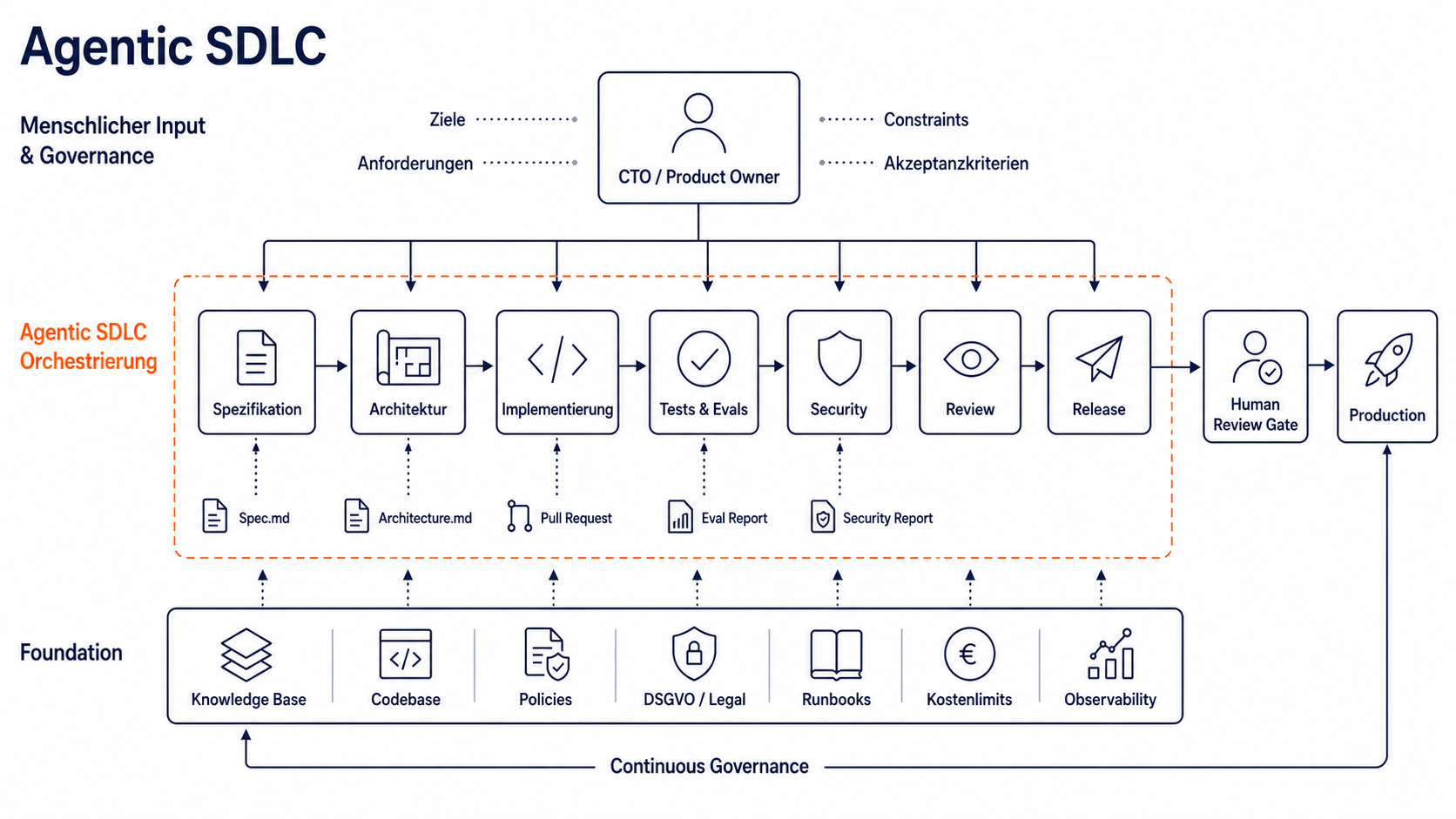
The bottleneck shifts with Agentic SDLC:
- From “Who writes the code?” to “Is the requirement clear enough?”
- From “Did anyone understand the ticket?” to “Do the agents have the right context?”
- From “Was it tested?” to “Are evals, security, and acceptance criteria solid?”
- From “How fast can we build?” to “How safely can we control agentic work?”
Agentic SDLC means more than new tooling. It means a new engineering operating model: with knowledge base, constraints, guardrails, evals, review gates, and clear accountability.
Want to understand where Agentic SDLC can move the needle in your engineering?
How We Work Together

Situation assessment
Where are you, where is your engineering with AI? What’s running, what’s stuck, what’s missing. No flying blind – first, the real picture.
Focus
Which AI decisions are urgent right now – architecture, tooling, team, roadmap? We prioritize before we act.
Sparring
Regular peer-level exchange. You bring your real questions from your day-to-day as a CTO – we work through them. No homework, no slides.
Execution
You lead the AI implementation – with a clearer head and a reference point. The decisions stay with you. I make sure they stand on solid ground.



Who This Sparring Is For
- CTOs who need to implement AI in their company – but don’t have a clear path yet
- CTOs who need to lead their team through AI transformation without it falling apart
- CTOs making architecture and tooling decisions alone – without colleagues who have real AI leadership experience
- Tech leads stepping into CTO-level AI accountability
- CTOs looking for CTO coaching for AI decisions – not a course, but real sparring
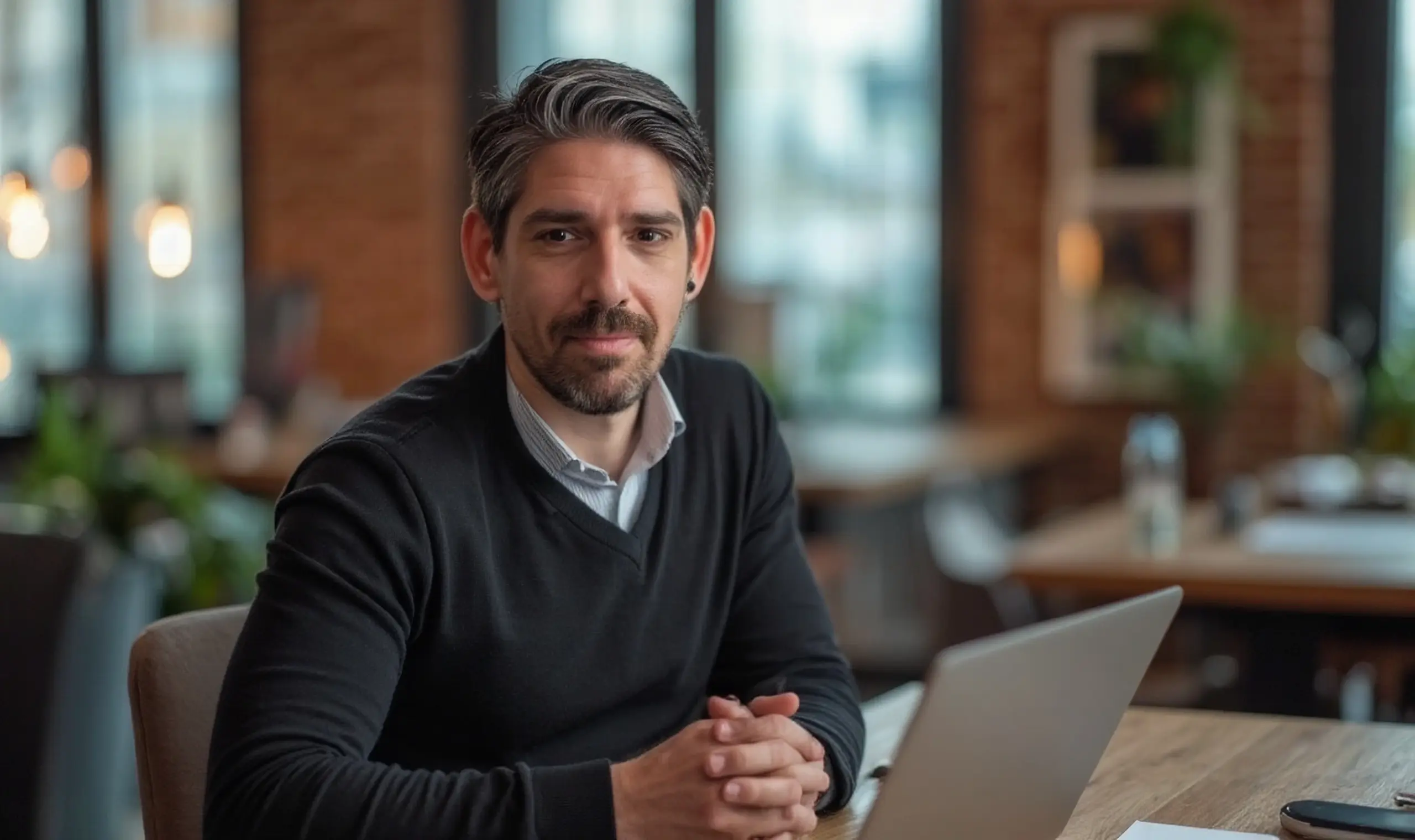

The question isn’t whether AI will change your engineering. The question is whether you’re the one leading that change.
Why now?
There’s enough guidance out there. What’s missing is someone who already knows the questions you’re asking right now – and who’s already been on the other side.
If you want to implement AI as a CTO without the chaos and without flying blind, let’s talk.
Über Philipp Deutscher Consulting
Philipp Deutscher Consulting stands for clarity, structure, and real impact in technology organizations – especially in critical moments. As a seasoned Interim CTO and Fractional CTO, I’ve led teams through complex AI transformations: with hands-on experience in architecture, engineering leadership, and the real questions that emerge when AI moves from proof-of-concept into the organization.
Not as a consultant who makes recommendations. As a leader who takes accountability – and as a sparring partner who thinks at the same level.
25+
Erfolgsgeschichten
What our clients say
Philipp is one of the rare professionals in his combination of being a proven CTO and with strong CEO capabilities. Philipp's strategic understanding and business expertise are exceptional. He demonstrated a profound ability to envision transformative business solutions. He inspires trust and confidence from everyone involved. His adeptness at navigating complex investment landscapes and his knack for fostering collaborative partnerships are truly commendable. Philipp is a visionary and experienced leader whose capabilities extend far beyond conventional consultancy, making him a highly recommended asset for any forward-thinking enterprise in the tech sector.
Marten von Velsen-ZerweckCEO, Noocoon

I've come to see Philipp not only as an exceptional tech leader, but also as a remarkably genuine and dedicated professional. His interpersonal skills and his natural ability to understand and connect with his team are truly a sight to behold. He guides his team members with compassion and empowers them to reach their full potential, all while fostering a sense of shared responsibility and commitment towards achieving our goals. Philipp's personal dedication to growth and results have been instrumental in driving the transformation within our organization. He is a true asset to any team, and I cannot recommend him highly enough.
Albrecht von SendenCTO, Tipico

Philipp's strategic and analytical approach proved invaluable during his tenure with TeamViewer, particularly during assignments requiring cross-cultural understanding and leadership. His problem-solving skills and profound management of technical complexities boosted our team efficiency, while his agile transformation expertise inspired a growth-oriented culture. The broad perspective and technical leadership expertise Philipp brought to the table was essential to our business success.
Dr. Mike EisseleCTO, TeamViewer

Philipp is the kind of leader who believes in getting the job done right - and he has the technical savvy and strategic insight to make it happen. His approach to technology and leadership isn't just about finding a solution; it's about finding the most efficient and innovative way forward. He's a champion for growth and accountability, consistently inspiring his teams to reach new heights. More than that, he ensures that every piece of the puzzle - from big-picture strategy to granular details - aligns perfectly. In my experience, that's the kind of leadership that drives real change and success.
Alexander WindbichlerCEO, Anexia

In my work with Philipp during our Agile transformation project at Tipico, I was continually impressed by his strategic thinking and the dedication he brought to excellence. His mix of tech expertise and dynamic leadership transformed not just systems, but also the people and the processes around them. If you're in the tech space and need a visionary leader who can effectively bridge the gap between technology and business, I highly recommend Philipp.
Karl BredemeyerManaging Partner, Netzwerkknoten, Unternehmensberatung GmbH

Philipp made a significant impact on our tech initiatives at BEONTRA. His blend of strategic vision, technical acumen and team leadership was instrumental in driving innovation and efficiency. Reflecting on his current role as an Interim CTO and Tech Leader, it's evident that his attributes continue to create transformative solutions in the tech industry.
Manuel HeidlerCEO, BEONTRA

Philipp is an authentic leader. Clear in his thoughts, mindful with his words and proactively giving direction. Finesse is important to him when it comes to building high performance teams in tech. I feel his impact and presence every time we meet. Sparring thoughts is always enriching with Philipp, he makes you think twice. There is no black and white with him, he respects the grey and and they change of matters and can find creative approaches for ambiguity. I would call this a true leadership skill for future-oriented organisational development.
Elisabeth Heckmann Executive Coach & Head of People Ryte, foobar Agency




Additional services
Schedule a no-obligation consultation now
Frequently Asked Questions
What’s the difference between CTO coaching and CTO AI sparring?
CTO coaching focuses more on personal development and the leadership role. CTO AI sparring is more concrete and decision-oriented: you bring your current questions on architecture, tooling, team, and strategy – and we work through them together. No curriculum, no lesson plan. Peer-level sparring.
Do I need to have AI projects already running to get started?
No. Sparring makes sense even if you’re just starting out and don’t yet know where the right entry point is for implementing AI in your company. That’s often exactly the most important question: where does AI actually create leverage – before resources flow in the wrong direction.
What is Agentic SDLC and why does it matter for CTOs right now?
Agentic SDLC is a new engineering operating model where specialized AI agents take over large parts of the software development process – from specification through testing to security checks. Humans remain at the critical points: goal-setting, context, review, sign-off. For CTOs, this isn’t just a tooling question – it’s an organizational and leadership question.
How is this different from an AI course or workshop?
A course teaches knowledge. Sparring solves your actual problems. You don’t come with a learning goal – you come with a decision, a problem, or a blind spot – and we work through it together. No homework, no slides. Your reality as a CTO is the starting point.
How long does a typical sparring engagement last?
It depends on the situation. Some come for targeted sessions when a specific AI decision is on the table. Others I work with over several months as they implement AI in their company and lead their team through the transformation. No fixed model – whatever the situation actually calls for.
When would an interim CTO make more sense than sparring?
If you don’t need support making your own decisions, but someone to make decisions for your company – because there’s no CTO in place or because things are urgent. In that case, an interim CTO is the right answer. Sparring is for CTOs who want to lead themselves – but with an experienced reference point alongside them.